The loudest sounds your neighbors make are the ones noise-canceling devices handle worst. Thumping bass, a shouting match at 11 PM, a dog losing its mind: these sharp, sudden disruptions are exactly what active noise cancellation struggles to process.
Most renters searching for a wireless fix imagine pressing a button and hearing silence. The physics tell a different story. These devices work best on soft, repetitive sounds: the exact noises people tolerate anyway.
This article is for apartment renters working from home who need focus during the day and sleep at night. If a neighbor’s TV hum or muffled conversation is wrecking your concentration, there is a device category worth knowing.
Why Active Noise Cancellation Fails at Neighbor Noise
The marketing around wireless noise-canceling devices leans hard on the word “canceling.” The actual mechanism, called destructive interference, generates an inverted copy of incoming sound waves through microphones and speakers.
Two waves collide, the volume drops. Simple enough on paper.
The Frequency Problem
Low, steady sounds are easiest to invert: think airplane cabin hum, HVAC drone, or distant traffic. A consistent wave pattern gives the processor time to predict and counteract. Neighbor noise rarely fits that profile.
A door slamming, a child screaming, bass from a subwoofer vibrating through a shared wall: these hit fast and at irregular intervals.
The algorithm cannot predict what comes next, so the inverted wave arrives a fraction late. The sound still gets through, just slightly muffled.
Where Cancellation Breaks Down
I would skip any wireless ANC panel if the primary problem is impact noise like footsteps or furniture dragging above a ceiling. Those vibrations travel through building structure, not air.
No speaker mounted on a shelf can counteract a wave that enters through the floor joists. That distinction between airborne noise and structure-borne noise decides whether the technology is even relevant to the problem.
Airborne noise from a TV two rooms away? Reasonable target. The couple upstairs who apparently rearrange their living room at midnight? A rug on their floor would do more than any device on yours.
The Real Lineup of Wireless Noise Devices
The category has expanded past headphones into room-level products. Each type solves a slightly different version of the problem, and mixing them up leads to expensive disappointment.
Wireless Noise-Masking Machines
These are the simplest option. A small speaker plays white noise, pink noise, or nature sounds on loop. The goal is not cancellation but masking: covering the neighbor’s sound with a constant layer so the brain stops noticing it.
I think masking machines around the $30 to $50 range, like the LectroFan or Dohm models, punch above their price for one specific scenario: consistent low-level noise that disrupts sleep. They will not touch a loud party.
Smart Speakers Running Sound Apps
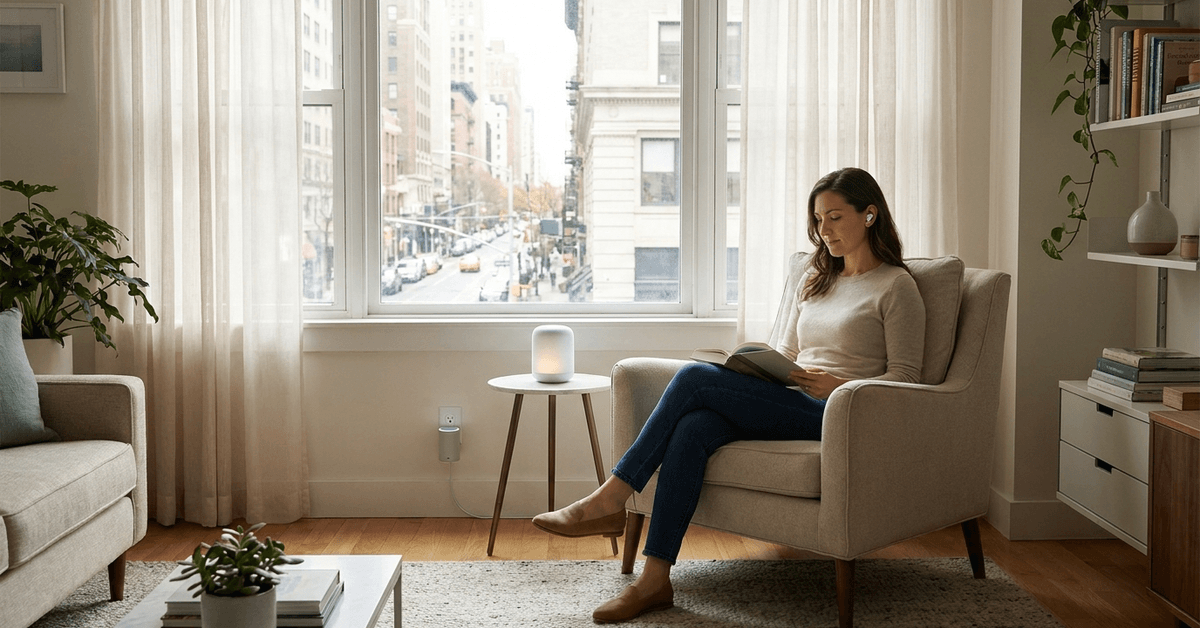
A Google Nest or Amazon Echo already sitting on a shelf can pull double duty. Several apps loop ambient soundtracks designed for masking. Pair two or three speakers across a room and the coverage improves.
There is a catch worth knowing. Bluetooth pairing across multiple speakers introduces latency, and even a 50-millisecond delay between two units creates an audible phasing effect.
Devices on the same Wi-Fi network using the manufacturer’s multi-room grouping tend to stay synchronized.
Wireless Active Noise-Canceling Panels
These are the newest and most expensive category. Wall-mounted panels contain microphones that sample room noise and emit anti-noise frequencies. The effect softens a room’s sound profile rather than eliminating specific disruptions.
A few things to know before spending on these panels:
- Cost climbs fast once a setup requires more than one panel for proper room coverage
- Placement matters: panels work best on the wall closest to the noise source, not the opposite side of the room
- Performance drops for sounds above roughly 1,000 Hz, which includes most human speech and higher-pitched music
The softening effect can be noticeable for general ambient reduction. But calling it “noise canceling” stretches what these panels deliver in a residential setting.
Personal Wireless Earbuds and Headphones
Over-ear headphones like the Sony WH-1000XM5 or Apple AirPods Max still outperform any room-level device at active noise cancellation.
The ear seal blocks sound passively, and the small internal drivers handle cancellation more effectively because the target area is tiny.
Smaller earbuds sacrifice some passive blocking but allow free movement around an apartment. For someone on video calls all day, a pair of ANC earbuds may solve 80% of the problem without touching the room itself.
Passive Methods Still Beat Most Wireless Gadgets
I would take a $200 budget and spend it on physical changes before any wireless device.
The raw physics supports this: a heavy bookshelf filled with books against a shared wall absorbs more broadband noise than a $200 wireless panel on the opposite wall. That comparison rarely appears in product reviews because there is nothing to link to or sell.
Soft Surfaces Absorb What Tech Cannot
Thick rugs on hard floors, heavy curtains over windows, and upholstered furniture all reduce sound reflection inside a room. The neighbor’s noise still enters, but it bounces fewer times and dies faster.
Sealing gaps is the cheapest single upgrade. A 1-inch gap under a door lets through as much sound as a small open window. Foam weatherstripping costs a few dollars and takes five minutes to install.
The Combination Approach
A sealed room with soft surfaces plus a $40 white noise machine running at night covers more ground than a $300 ANC panel in a bare, echoey apartment.
Stacking passive and active methods compounds the reduction, while relying on wireless tech alone in a reflective room just adds another layer of sound to an already noisy space.
| Feature | White Noise Machine | Wireless ANC Panel | ANC Headphones |
|---|---|---|---|
| Price range | $20 to $80 | $150 to $500+ | $100 to $550 |
| Best for | Sleep, steady background masking | General room softening | Focused work, calls, commuting |
| Handles sudden loud noise | Masks partially | Poorly | Moderately well |
| Requires wearing something | No | No | Yes |
| Setup complexity | Plug in, turn on | Mounting, calibration, app | Charge and pair |
ANC headphones remain the strongest option per dollar for personal noise reduction, but they are not a room solution.
Mistakes People Make When Buying Noise Devices
No consumer device creates silence. The term is a marketing shorthand for partial reduction. Expecting total silence leads to returns and frustration. A more honest framing: these devices lower the volume of certain sounds by a few decibels.
Ignoring the Masking Layer Itself
One detail that surfaces in user complaints but almost never appears in buying guides: some people find the masking sound more distracting than the original noise.
A white noise machine hissing all night can become its own problem for light sleepers sensitive to high-frequency content. Pink noise or brown noise, which sit lower on the frequency spectrum, tend to bother fewer people.
Trial periods matter here. Buy from retailers with a return window, test for at least a week, and pay attention to whether the masking layer itself affects sleep quality.
Skipping the Physical Fixes First
Spending $400 on wireless panels while a gap under the bedroom door lets in half the hallway noise is solving the problem backwards.
A basic guide from the EPA on noise pollution explains how sound travels through structures, and that context helps prioritize which fixes come first.
Questions People Ask About Wireless Noise Canceling for Apartments
These come up often enough to address directly.
- Q: Can wireless noise-canceling devices block bass from a neighbor’s subwoofer? Bass frequencies travel through walls and floors as vibrations, not just air. No wireless speaker can counteract that. Physical decoupling, like rubber isolation pads under the neighbor’s subwoofer, is the only effective fix, and that requires their cooperation.
- Q: Do noise-masking machines use a lot of electricity? Most run between 5 and 18 watts, roughly the same as a phone charger. Leaving one on overnight for a full year adds a negligible amount to an electricity bill, typically under $10 annually depending on local rates.
- Q: Can I use ANC earbuds while sleeping? Some people do, but standard earbuds press against the ear when lying on a side. Sleep-specific earbuds like Bose Sleepbuds sit flatter and use masking rather than active cancellation. Comfort over an eight-hour stretch matters more than the noise reduction spec.
Conclusion
The gap between what wireless noise tech promises and what apartment walls allow is wider than most product pages admit. Knowing where that gap sits saves money and frustration.
Pair a $40 masking machine with a sealed door and a heavy bookshelf, and the expensive wireless panel may never need to enter the conversation at all.